

 ER
ER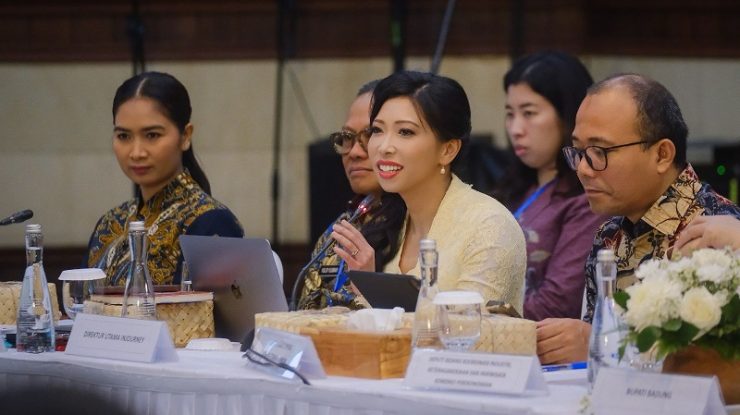

THE STATE-OWNED holding company in the aviation and tourism sector, PT Aviasi Wisata Indonesia or InJourney, recently participated in a dialogue between the government and tourism industry players in Bali.
On this occasion, InJourney’s President Director, Maya Watono explained the various challenges faced by the tourism industry in Bali, accompanied by proposed solutions. With this participation, InJourney hopes to contribute to improving Indonesian (RI) tourism that is globally competitive.
The dialogue with tourism sector business actors was also attended by Vice President Gibran Rakabuming, Minister of Tourism Widiyanti Putri Wardhana, Minister of MSMEs Maman Abdurrahman, Governor of Bali Wayan Koster, Deputy Minister of Tourism Ni Luh Puspa, as well as representatives of ministries and institutions, all Regents and Mayors from the Province of Bali.
Also followed by business players from PHRI (tourism); ARKI (tourist travel services); GAHAWISRI (tourism business); ASPERAPI, INCCA, IVENDO (organizer of MICE activities); INACA (tourist transportation services), GIPI (Indonesian Tourism Industry Association) and so on.
The aim of this dialogue is to absorb aspirations directly from business actors, in order to strengthen steps towards increasingly advanced and competitive Indonesian tourism.
InJourney President Director Maya Watono conveyed three main challenges facing the Indonesian aviation and tourism sector which need to be addressed in an integrated manner to strengthen the competitiveness of the Indonesian aviation and tourism ecosystem.
She added that this mapping places three main priorities, namely connectivity, infrastructure and accommodation, as well as destination development and promotion.
“In terms of connectivity, the main challenges are still seen in the limited domestic flight fleet, limited direct international flights to various airports in Indonesia, and the lack of optimal incentive and partnership schemes to attract and maintain international airline routes,” she said.
Maya explained, to answer this, InJourney is encouraging steps to strengthen connectivity through evaluating several regulations related to connectivity that can increase inbound traffic in priority tourism destinations as well as providing incentives for opening new routes combined with joint promotion programs with inbound airlines.
In terms of infrastructure and accommodation, the increase in traffic at I Gusti Ngurah Rai International Airport has not been fully offset by adequate access to the airport. Apart from that, land connectivity between priority destinations is still limited by road infrastructure that is not yet optimal.
“As a solution, InJourney emphasizes the importance of aligning the development of integrated intermodal transportation as the main access to the airport, accelerating infrastructure improvements in priority destinations such as roads, utilities, and alternative land accessibility such as water taxis, toll road support and accessibility for tourism areas,” Maya affirmed.
Meanwhile, in destination development and promotion, strengthening destination branding and marketing, especially anchor attractions, still requires stronger promotional support to create sustainable attraction and increase length of stay.vIn addition, funding and incentive schemes to attract and maintain international events on a global scale are still limited.
InJourney, she continued, proposed providing incentives for travel agents as a catalyst for regional promotion and development, providing financial incentives for external activities that promote key destinations such as film production, collaboration with global travel agents, as well as creative industry-based promotions.
Apart from that, InJourney encourages the formation of a Quality Tourism Fund as funding support for international events such as MotoGP, concerts and various other global events.
“Through this issue mapping, InJourney emphasizes the need for cross-stakeholder collaboration so that strengthening connectivity, accessibility and destination promotion can run in one policy orchestration. The final target is clearly to create sustainable tourism growth and have a real impact on the local and national economy,” concluded Maya Watono. [traveltext.id/photo special]