

 ER
ER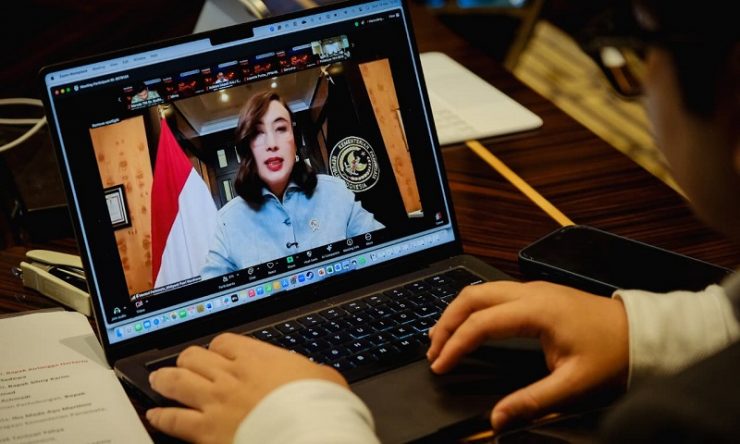

THE INDONESIAN Ministry of Tourism is preparing a number of strategic steps to maintain the growth momentum of Indonesia’s tourism sector amidst global geopolitical dynamics that have the potential to impact international tourist connectivity and mobility.
In the National Webinar “Tourism Under Fire” organized by the NHI Bandung Alumni Association on Monday (03/16/2026), Minister of Tourism Widiyanti Putri Wardhana explained that the global geopolitical situation is beginning to impact airline operations, including adjustments to long-haul flight routes and increased travel costs due to soaring fuel prices.
The Middle East has long been a strategic hub for tourists from Europe and America to Indonesia. Developing geopolitical conditions in the region have the potential to impact international travel to Indonesia.
The government estimates that the potential direct impact on foreign tourist arrivals could reach around 4,700 to 5,500 people per day. If these conditions persist, the potential loss of foreign exchange is estimated to range from IDR157.9 billion to IDR184.8 billion per day.
“Indonesian tourism is actually enjoying excellent momentum. In 2025, we will record 15.39 million international tourist visits, generating foreign exchange of US$18.27 million. Although Europe, the Middle East, and the Americas only account for 21.7% of total visits, their foreign exchange contribution reaches 34.7% because they are high-spending tourists,” said Widiyanti Putri Wardhana.
To anticipate these potential impacts, the Ministry of Tourism has prepared five main mitigation strategies.
The first strategy is to diversify the international tourist market by strengthening promotions in short- and medium-haul markets with relatively stable flight connectivity, such as Southeast Asia, East Asia, Australia, and India.
In the near future, potential tourists will see more promotional campaigns showcasing Indonesia as an attractive, safe, and stable alternative destination.
The second strategy is to optimize direct flights, including the Amsterdam-Jakarta and Amsterdam-Denpasar routes operated by Garuda Indonesia. This step is expected to continue attracting tourists from the European market, especially ahead of the spring and summer holiday seasons.
The third strategy is strengthening data-driven digital promotions to reach potential tourists more precisely, while simultaneously increasing the effectiveness of Indonesian tourism campaigns in various potential markets.
The fourth strategy is strengthening the movement of domestic tourists by encouraging Indonesians to travel domestically. This effort becomes increasingly relevant, especially ahead of the Eid al-Fitr holiday, which is usually accompanied by increased public mobility.
The fifth strategy is encouraging the holding of various tourism events in border areas to maintain the dynamics of the tourism economy in various regions. Tourists from neighboring countries like Singapore who visit the Riau Islands, for example, tend to make repeat visits.
“Therefore, this opportunity needs to be optimally utilized, including by offering golf tour packages, shopping tours, wellness, and various other tourism experiences,” Widiyanti affirmed.
Furthermore, the Minister of Tourism also emphasized the importance of collaboration across ministries and institutions, including the Ministry of Transportation, the Ministry of Immigration, and the Ministry of Finance, to explore various policies that can strengthen Indonesia’s tourism competitiveness.
Some options being promoted include increasing flight capacity, increasing ticket affordability, and introducing visa-free policies for potential markets.
“These measures are crucial to improving Indonesia’s tourism competitiveness amidst the global situation that requires responsive and adaptive strategies,” Widiyanti Putri Wardhana underlined.
Amid these challenges, the Minister of Tourism also highlighted positive developments in the East Asian market. Several airlines, such as China Airlines, Spring Airlines, and China Southern, are reportedly planning to increase flight frequencies and open new routes to Jakarta and Bali starting in May 2026.
“With the right strategy and solid collaboration, I am confident that Indonesia’s tourism sector will continue to grow sustainably, inclusively, and become increasingly competitive globally,” said the Minister of Tourism.
Meanwhile the Coordinating Minister for Economic Affairs of the Republic of Indonesia, Airlangga Hartarto, stated that Indonesia’s tourism sector recorded impressive performance throughout 2025, contributing IDR945.7 trillion, or 3.97%, to Gross Domestic Product (GDP).
However, amid these positive achievements, Coordinating Minister for Economic Affairs Airlangga emphasized that the sector’s resilience is being tested by geopolitical challenges in the Middle East, which are disrupting global connectivity. Based on projections from the Ministry of Tourism, this disruption has the potential to result in a loss of 5,500 foreign tourists and foreign exchange worth IDR 184.8 billion per day if not immediately mitigated.
“Indonesia needs to immediately implement reforms to mitigate losses due to the global crisis and build a tourism foundation with competitive, resilient, and internationally competitive destinations,” Airlangga said.
Airlangga also revealed that he will prepare strategic steps, such as strengthening the domestic market through micro-tourism, promoting destinations for digital nomads, and outlining marketing to highlight Indonesia as a high-end, affordable destination.
“And of course, collaboration and synergy are needed to ensure the resilience of the tourism ecosystem,” Airlangga concluded. [traveltext.id]