

 ER
ER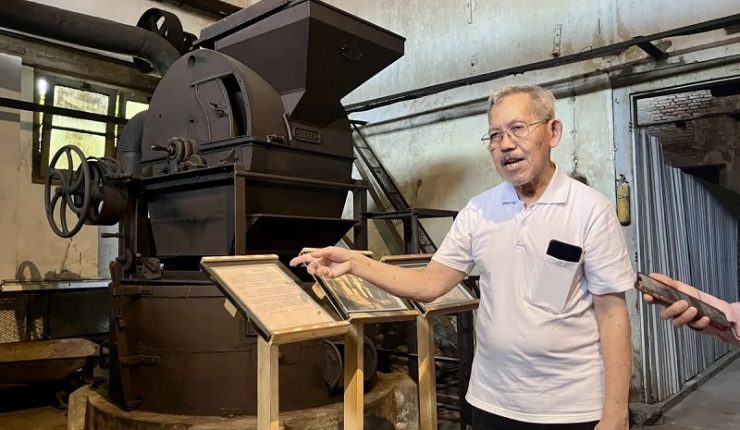

THE OLD building on Jalan Wotgandul Barat, Semarang, feels like a timeless piece that refuses to fade. Its walls hold the scent of history, while the machinery and traditions within continue to function despite a century of change.
This is where the legendary Koffie Branderij Margo Redjo coffee factory, established in 1915, remains, transforming into Dharma Boutique Roastery, a family-owned coffee business devoted to preserving the legacy of flavors passed down through generations.
First established in Bandung during the Dutch colonial era, the coffee factory was moved to Semarang in 1926. Since then, its pulse has never truly stopped, making it one of the oldest surviving traces of the coffee industry, continuing to operate to this day.
“It was founded in Bandung in 1915. Although my grandfather was born in Semarang, or in this house as well. But in 1926, he moved the business, including the machinery, to Semarang, to his birthplace, on Jalan Wotgandul Barat,” said Dharma Boutique Roastery owner Hidayat Basuki Dharma Wiyono on Thursday (March 19).
He explained that the current business name is a new identity he chose himself, replacing the old name, which was no longer used due to trademark piracy issues.
“The old name was pirated and we no longer used it. Finally, I chose the new name, my own,” he said.
He explained that the use of the word “boutique” reflects the business’s approach, which strives to serve coffee according to the consumer’s taste, while still prioritizing quality.
Commitment to local coffee and quality
Dharma emphasized that all the coffee sold is authentic Indonesian coffee sourced from various regions, from Aceh to Papua, with around 50 types of coffee beans.
“We don’t sell imported coffee. Everything is from Indonesia,” he said.
According to him, this decision is a form of support for domestic coffee farmers and an effort to maximize the potential of local coffee, which is considered to be on par with foreign coffee.
“In terms of taste, our coffee is not inferior. We want the results to go back to Indonesian farmers,” he said.
He believes the current development of the coffee industry is rapidly increasing, driven by advances in distribution and the involvement of the younger generation with educational backgrounds in agriculture.
“Now, many young people are getting involved in knowledge. So coffee processing is more developed,” he said.
Various coffee processing methods, such as wet, dry, and fermentation with varying time intervals, contribute to increasingly diverse flavor characteristics.
“Now, one type of coffee can have many flavors depending on the process,” he said.
Tradition, education, and the experience of enjoying coffee
Amidst the development of the modern coffee industry, Dharma Boutique Roastery maintains its manual roasting method using a 100-year-old machine that is still in use today with the addition of a motor.
“We still use manual methods. The results are no less, but now they are more science-based,” said Dharma.
He added that his company doesn’t prioritize low prices, but rather the quality of the product.
“We don’t sell cheaply, but we also don’t raise prices arbitrarily. Prices reflect quality,” he said.
The experience of visiting this coffee boutique also offers a unique experience. The seating area is dominated by an open space with a paved courtyard surrounded by green plants and shady trees, creating a calm and comfortable atmosphere. The building, which still maintains its old architecture with classic windows and a tiled roof, reinforces the historical feel that blends with modern activities.
Visitors can sit at simple wooden tables and chairs while enjoying the tranquil atmosphere, far from the bustling modern cafe scene.
The location neatly displays around 50 varieties of coffee beans from various regions in Indonesia. Before purchasing, visitors are allowed to smell the beans directly to identify the characteristics of each variety.
The baristas also actively explain the origins, processing, and flavors of the coffee, making the purchasing process more informative.
This approach makes the visit not just a coffee purchase but also an educational experience for coffee lovers.
“We’re just introducing them. Whether they’re interested or not is up to each individual,” said Dharma.
He said education is an important part of building an understanding of coffee, both for employees and customers.
“At first, I didn’t know, but I learned from experience. Now they (the baristas) are even smarter than me,” Dharma added.
Dharma also revealed that the growing public interest in coffee is also influenced by popular culture, such as the film “Filosofi Kopi,” which broadens public interest.
Every day, he and his team conduct taste tests and blending to maintain consistent product quality. “We always taste the coffee we sell and blend it,” he said.
He views coffee as an art form with no single standard for evaluating taste. “Coffee is a never-ending art. There’s no such thing as the best coffee because everyone has their own taste,” Dharma said.
Currently, Dharma Boutique Roastery’s production is still small-scale, with a daily capacity of less than one quintal. Dharma said his business once exported, but this was halted due to the global economic crisis and World War II. “We’re still small,” he concluded. [antaranews]