

 ER
ER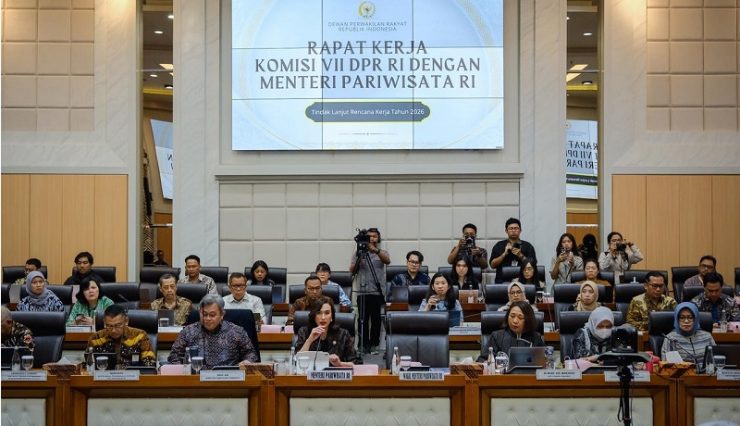

THE INDONESIA Ministry of Tourism presented its 2026 work plan during a joint working meeting with Commission VII of the Indonesian House of Representatives (DPR RI), led by the Chairman of Commission VII, Saleh P. Daulay. The government affirmed its commitment to maintaining the solid performance of the tourism sector, despite facing dynamic global challenges.
In her presentation, Minister of Tourism, Widiyanti Putri Wardhana, explained that the Ministry of Tourism’s priority program for 2026 is directed at strengthening quality tourism that is safe, sustainable, and has a positive impact on the local economy.
“One of the main focuses is improving tourism safety through competency-based training and certification for tour guides, developing destination safety guidelines, and mapping disaster-prone tourist areas. In addition, the government is also strengthening the development of more than 6,200 tourist villages through community mentoring, village certification, and strengthening local tourism-based economic networks,” she said.
Quality tourism will continue to be strengthened by continuing the Wonderful Indonesia Gastronomy, Wonderful Indonesia Wellness, Events by Indonesia programs, and developing the digitalization of Indonesian tourism through the Tourism 5.0 program, which began in 2025.
According to her, amidst efforts to strengthen these programs, the global tourism sector is currently facing the impact of the conflict in the Middle East. The closure of Iranian airspace from February 28 to March 28, 2026, caused flight disruptions from six major international aviation hubs—Abu Dhabi, Doha, Dubai, Jeddah, Medina, and Muscat.
“These six hubs contributed to the cancellation of approximately 770 flights to Jakarta, Bali, and Medan. This situation is estimated to result in a potential loss of around 60,000 international tourist visits, with potential unrealized foreign exchange earnings reaching approximately IDR2.04 trillion,” she affirmed.
Minister Widiyanti also explained that global geopolitical dynamics certainly put pressure on the tourism sector. However, we continue to take mitigation measures to maintain national tourism performance targets.
Pressure on the tourism sector also arises from rising global energy prices. Global crude oil prices increased by more than 52%, from around US$67 per barrel to over US$102 per barrel within a month. This situation triggered an increase in transportation costs through the implementation of fuel surcharges by various international airlines and increased fares for cross-border transportation.
Facing this situation, the Ministry of Tourism has prepared several mitigation strategies to maintain the target of 16–17.6 million international tourist visits by 2026.
These strategies include pivoting the market to Southeast Asia, East Asia, and medium-haul markets, strengthening international digital campaigns, and optimizing collaboration with airlines with direct routes to Europe and the Americas.
The government is also encouraging the holding of cross-border events in border areas and strengthening the promotion of domestic tourism to maintain occupancy rates at domestic tourist destinations.
“Amidst global pressure, we need to be more adaptive. Market diversification, strengthening promotion, and optimizing domestic tourism are key to ensuring the tourism sector remains a driver of the national economy,” she noted.
Furthermore, the Minister of Tourism emphasized that achieving national tourism performance targets requires support across ministries and agencies. The government is promoting a number of strategic measures, such as providing relevant flight incentives, visa-free travel policies, increasing airline seat capacity, and strengthening the tourism promotion budget to ensure Indonesia remains competitive amidst global competition.
Meanwhile, the Chairman of Commission VII, Saleh Daulay, appreciated the Ministry of Tourism’s prepared mitigation strategies to address global dynamics. Commission VII also requested strengthening connectivity and the movement of domestic tourists amidst the current global uncertainty.
Likewise, Putra Nababan, a member of Commission VII from the Indonesian Democratic Party of Struggle (PDIP), asked the Ministry of Tourism to study the shifting patterns resulting from this strategic change, citing differences in behavior between long-haul (Europe and America) and medium-haul (East and South Asia) and short-haul (ASEAN) travelers.
Putra specifically requested that the government immediately grant visa-free travel, especially to Chinese and Australian tourists, so that this shift in the Ministry of Tourism’s strategy becomes national policy.
“Let there be no more sectoral egos. We support the Minister leading the government’s visa-free travel for tourists, especially Chinese and Australian,” Putra Nababan concluded. [traveltext.id]