


 ER
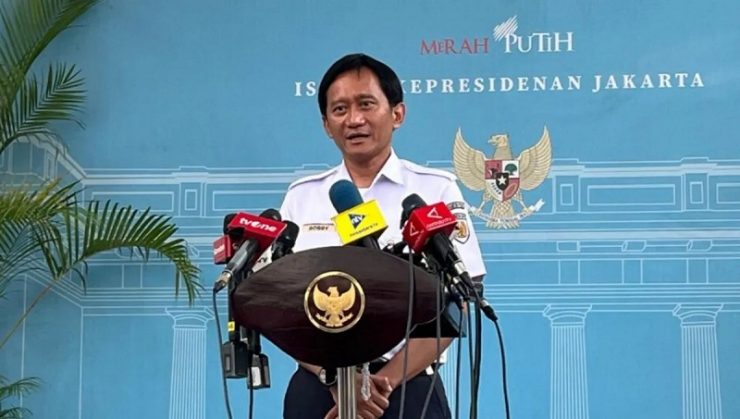

PRESIDENT Director of PT Kereta Api Indonesia, Bobby Rasyidin, presented a railway development program for Bali to President Prabowo Subianto during a meeting at the Presidential Palace Complex in Jakarta on Thursday (011/05), 2026.
Bobby stated that this plan was one of two key topics discussed with the President, alongside the accelerated revitalization of Gambir Station, which is set to be integrated with the National Monument (Monas) area.
“We presented a development program for a railway in Bali. The first phase of the railway service in Bali will run from Ngurah Rai [Airport] northward—through Kuta, Legian, and Seminyak—ending in Canggu,” Bobby explained following the meeting.
He clarified that the railway development plan is divided into two phases: the first phase connects I Gusti Ngurah Rai Airport to Legian, while the second phase extends from Legian to Canggu.
Bobby noted that the entire development process for both phases is expected to take approximately two years.
“The Bali railway—or Bali tram—will be implemented in two stages: the first phase from Ngurah Rai to Legian, and the second phase from Legian to Canggu. This will take two years to complete,” he said.
In addition to outlining the development plan, Bobby revealed that KAI estimates the budget required for the Bali railway project to exceed IDR 2 trillion.
“We indicated that the budget for the Bali railway is over two trillion rupiah,” he stated.
Previously, the Bali Provincial Government, the Badung Regency Government, and PT Kereta Api Indonesia (Persero) officially signed a cooperation agreement to develop a battery-powered electric tram system—a form of mass transit—running from I Gusti Ngurah Rai Airport to Canggu. The project aims to alleviate traffic congestion and support the tourism sector.
“The comfort of tourists must be maintained; in fact, the tram is expected to serve as a new attraction for tourism in Bali,” said Bali Governor Wayan Koster following the signing of the agreement in Denpasar on Tuesday (September 1).
Koster stated that the signing of the agreement—attended by the Regent of Badung, the President Director of PT KAI, the CEO of Angkasa Pura, and the Badung Regional Secretary—serves as a follow-up to a proposal initiated by the Ministry of National Development Planning (Bappenas) and the Bali Provincial Government.
The electric tram system is increasingly seen as a concrete solution to traffic congestion along the corridor between I Gusti Ngurah Rai Airport and Canggu, an area that sees a daily movement of up to 150,000 people and 80,000 vehicles.
He emphasized that, beyond supporting tourism, the 12-kilometer electric tram line will be carefully planned to account for existing hotels, tourist accommodations, attractions, the environment, residential areas, and the daily lives of the local community.
Governor Koster underscored that infrastructure development must not disrupt Bali’s ecosystem.
“The development of transportation must remain mindful of Bali’s unique character, preserve its beauty, support tourism, and avoid disrupting the lives of the local people,” he concluded. [antaranews]