


 ER
ER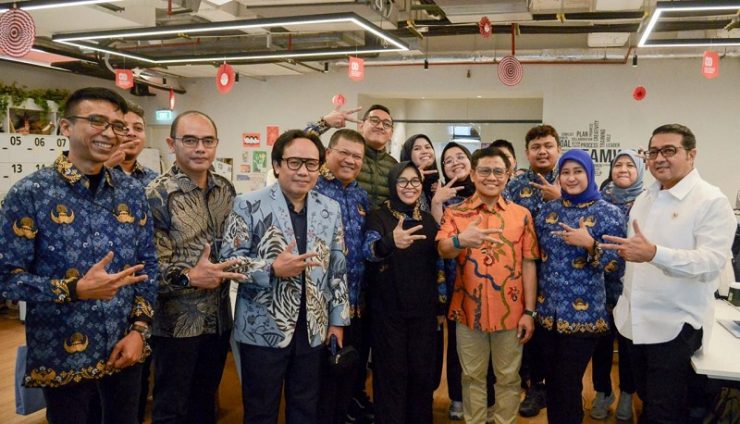

FOLLOWING the National Medium-Term Development Plan (RPJMN) target, Coordinating Minister for Community Empowerment (Menko PM), Muhaimin Iskandar, recently paid a working visit to the Ministry of Creative Economy (Ekraf) office at Autograph Tower, Jakarta. This visit served as a momentum to strengthen cross-ministerial coordination in encouraging the development of the creative industry as a new engine of national economic growth.
During the meeting, the PM Cordinating Ministry iscussed policy directions and targets for strengthening the creative industry by 2026 with the Minister of Creative Economy (Ekraf), Teuku Riefky Harsya. This coordination also addressed the challenge of budget constraints, which are considered to still limit the government’s scope for intervention in encouraging more extensive development of the creative economy sector.
“We sincerely hope and will continue to convince the President and the Minister of Finance that the Ministry of Creative Economy’s intervention budget will be even broader. The amount will increase according to needs. And most importantly, the intervention can be more massive. Meanwhile, the focus on local IP can be shifted to national levels, and those already national can go global. Not only IP but also larger industries,” explained Muhaimin Iskandar.
On the same occasion, Minister of Creative Economy (Ekraf), Teuku Riefky Harsya stated that over the past year, the Ministry of Creative Economy has made a real contribution to increasing the national Gross Domestic Product (GDP). He emphasized that the creative economy development targets, as directed by President Prabowo Subianto in the 2025 National Medium-Term Development Plan (RPJMN), have not only been achieved but have even exceeded them.
This positive achievement is reflected in investment and employment data. According to BKPM data, creative economy investment realization in the first semester of 2025 reached 66%, or IDR90.12 trillion, of the investment target of IDR123.9–136.3 trillion. Meanwhile, data from the Central Statistics Agency (BPS) shows that the number of workers in the creative economy sector has reached 27.4 million, exceeding the 2025 RPJMN target of 25.55 million.
“It can be seen that Indonesia’s creative economy is not just a stagnation, but has become a new engine of the national economy. The creativity of the nation’s youth has strong cultural roots, so it needs a little more encouragement with technological innovation in this digital age, so that local heroes can rise to the national and international levels,” Teuku Riefky affirmed.
Furthermore, the Minister also revealed plans to strengthen financing through People’s Business Credit (KUR) for the intellectual property-based creative industry by 2026, with a ceiling of IDR10 trillion. This scheme allows creative industry players to obtain credit ranging from IDR100 million to IDR500 million per entrepreneur, with existing IP as collateral. This step is expected to facilitate access to financing, strengthen the creative ecosystem, and encourage the emergence of superior, highly competitive IP.
“Although currently only used as collateral, it can be used and makes it easier for IP owners to apply for KUR (People’s Business Credit) with banks,” he concluded. [traveltext.id]