

 ER
ER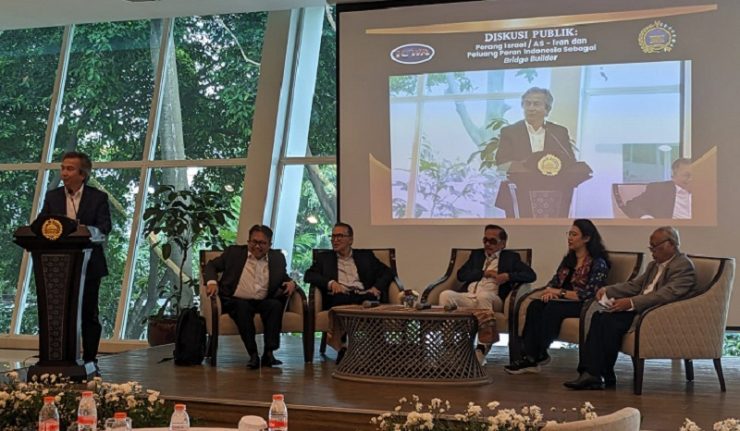

THE INDONESIAN Council on World Affairs (ICWA) held a discussion entitled “Public Discussion: The Israel/US-Iran War and Indonesia’s Opportunity as a Bridge Builder” on Wednesday (5/06), 2026 at the Diplomatic Canteen Hall, 2nd Floor, Ministry of Foreign Affairs of Indonesia. This discussion provided useful insights for Indonesia on the dynamics and constellation of global geopolitics and geoeconomics, as well as Indonesian foreign policy.
The event was opened by Ambassador AL Busyra Basnur, Chair of the Executive Board of the Indonesian Council on World Affairs (ICWA); Ambassador Denny Abdi, Secretary General of the Indonesian Ministry of Foreign Affairs; and Ambassador Santo Martosumarto, Director General for Asia, Pacific, and Africa, Ministry of Foreign Affairs of Indonesia.
The discussion featured speakers including: Dr. Nasir Tamara, Middle East Expert/Chairman of the SATUPENA Advisory Board; Air Marshal (Ret.) Chappy Hakim, Chief of Staff of the Indonesian Air Force (2002-2005)/Chairperson of the Indonesian Air Power Study Center, Dr. Dinna Prapto Raharja. Founder of Synergy Policies/Member of the Supervisory Board, Indonesian Council on World Affairs (ICWA). Dr. Sutrisno, Lecturer in the Doctoral Program in Economics and Development Studies, Borobudur University.
According to Retired Air Marshal Chappy Hakim, who is also the chairman and founder of the Indonesian Air Power Study Center, the idea of reviving the Aviation Council, which was established in 1955, is increasingly relevant amidst the current complexity of managing Indonesian airspace.
“It is at this point that the idea of reviving the Aviation Council becomes highly relevant. “I believe Indonesia is currently facing major challenges in the form of overlapping authorities, increasing aviation activity, and technological advances that are far faster than bureaucratic processes,” he said.
Chappy Hakim explained that without a permanent coordination mechanism like this, I believe air sovereignty management will continue to be partial and patchwork. However, I also regret that this strategic idea was not included in the recently passed law.
According to him, Indonesia needs a permanent coordination forum that can serve as a “common table” for all airspace stakeholders, from defense, aviation safety, intelligence, economics, law enforcement, to search and rescue.
Chappy proposed that the Aviation Council be mandated to synchronize civil and military aviation, with alternating leadership between the ministers of defense and transportation, and the chief of staff of the Indonesian Air Force as a permanent member.
“The Aviation Council will be a strategic forum so that every decision in Indonesian skies is viewed holistically, not from a sectoral perspective,” he emphasized.
Meanwhile, senior journalist and Middle East political observer Nasir Tamara offered his response to the joint United States (US) and Israel attack on Iran. The US-Israel attack on Iran, which was carried out on Saturday, (02/28), 2026, has sparked tensions in the Middle East.
However, Nasir Tamara believes that the US-Israeli attack on Iran on Saturday morning was not surprising considering its history. It’s not surprising at all, since the Islamic Republic of Iran was founded in 1979, after the victory of the Iranian revolution under Imam Khomeini.
“One of the goals of the Republic is to help Palestine and destroy Israel as a state. Therefore, Israel is considered to have hated Iran for a long time. So we must remember that this is the only country that has made such a decision. So, of course, during the 47 years of the revolution, Israel has hated Iran very much,” he said.
He believes the presence of these various weapons systems shows that Iran has long been preparing for the possibility of open conflict, including an escalation with the United States and Israel.
“If it hadn’t prepared itself as well as possible, it would have collapsed. And we see that it has a very powerful war strategy,” he affirmed.
According to Nasir, this military readiness is part of a multi-layered defense strategy designed to ensure Iran’s resilience amidst growing geopolitical pressure in the Middle East.
Nasira Tamara was the only Indonesian journalist to have traveled on a plane with Ayatollah Khomeini from France to Iran in 1979.
Likewise, international relations observer and founder of Synergy Policies, Dinna Prapto Raharja, warned that the impact of the conflict between the United States and Iran is not only geopolitical. Indonesia also faces serious economic and humanitarian threats.
She revealed that the situation in the region has already impacted the safety of Indonesian citizens. A number of migrant workers in the Middle East are said to be facing difficult conditions.
“Indonesian workers in Lebanon and several Gulf countries are simply left with their employers, unpaid, uneducated, and essentially left to guard houses. The humanitarian risks are very serious,” Dinna explained.
Furthermore, the economic risks are considered much broader. Indonesia could potentially face disruptions in the supply of essential materials, such as petrochemical products. “So, another looming problem is the petrochemical products that are desperately needed to process mining products in Indonesia. We know that our exports are heavily dependent on the mining sector,” she noted.
She added that to strengthen Indonesia’s position in diplomacy, I believe Indonesia needs to strengthen diplomacy by optimizing various cooperation platforms to maintain relevance at the global level while promoting the spirit of multilateralism. Indonesian diplomacy needs to be recalibrated to produce real impact, not just symbolic ones.”
One proposed step is to assign diplomats and ambassadors to provide fresh input on existing and emerging multilateral channels, including determining Indonesia’s position, methods, and objectives for involvement. [traveltext.id]