


 ER
ER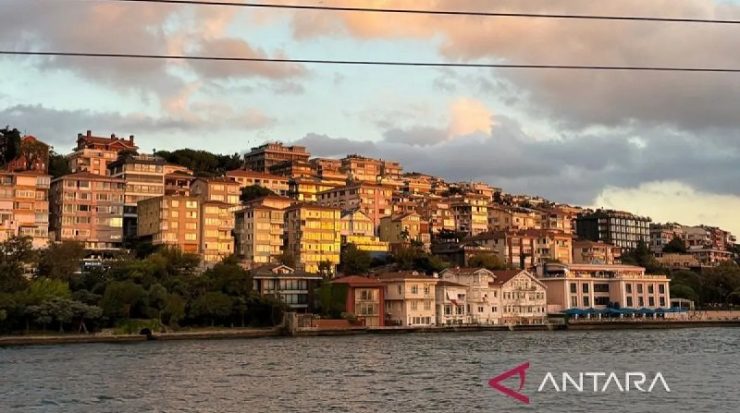

ISTANBUL, Türkiye, not only divides two continents, but also holds the remains and silent witnesses of the era of two giant empires, namely the Byzantine Empire and the Ottoman Empire.
On the European side, Topkapi Palace is one of them. Located on the Sarayburnu hill overlooking the Bosphorus Strait and the Sea of Marmara, the palace with a mix of Ottoman, Byzantine and Persian styles stands majestically.
The 700 thousand square meter palace complex was built by Sultan Mehmed II (1444–1445 and 1451–1481) in the period 1460–1478, following the conquest of Istanbul, which functioned as the sultan’s main residence and center of government until the mid-19th century.
The building complex is divided into four parts, namely the Outer Palace which includes supporting buildings and guard posts, then the state council building which is the administrative center of the sultanate, then the palace school, and the harem which is the sultan’s private residence.
Entering the 1840s, the palace was deemed no longer adequate for the needs of state protocol, so the Dolmabahçe Palace was built between 1843 and 1856 as the official residence and administrative center of the new empire.
Shortly after the Republic of Türkiye was founded on 29 October 1923, Topkapı Palace was converted into a museum; the first museum founded during the Republic.
Now, this UNESCO World Heritage Site has become one of the most iconic buildings in Istanbul, especially on the European side. Palaces include buildings with high domes and residential buildings made of stone and wood with lead-covered domes.
Harem
Among the buildings in Topkapi Palace, the Harem steals the attention of visitors in terms of its architecture. This was home to the sultan, members of the Ottoman dynasty, as well as those responsible for serving and protecting the imperial household, one of which was the black eunuchs.
The harem was not a single room but rather a complex network consisting of many rooms of various sizes including the sultan’s apartment, kitchen, courtyard, and baths.
The Main Gate of the Harem is not just a physical entrance but also functions as an architectural threshold that defines the boundaries of privacy, order, and sanctity between the Harem and the outside world.
The front of the gate is decorated with rumi motifs, a curved decorative style, at the top, functions as a screen that blocks the view towards the main gate from the stone-floored courtyard to emphasize the privacy and spirituality of the Harem. The gate leaf also has an arch, made of bronze.
Meanwhile, the surface of the walls surrounding the Harem gate is decorated with cypress-patterned iznik tiles, a classic Ottoman style.
In Ottoman art, the cypress tree symbolizes immortality, dignity, and unity. Its evergreen leaves symbolize eternal life, while its upright posture symbolizes submission to Allah, the Creator.
In particular, iznik tiles made with quartz as a base material have bright colors and high durability thanks to the underglaze technique (coloring under a layer of glaze).
Therefore, the Harem gate with its architectural form and tiled decoration is not just an aesthetic element but a symbolic expression of privacy, spirituality and orientation towards the divine order.
The harem also has a large hall with a dome decorated with 17th-century iznik mosaics and European-style painting panels. This hall is a place of ceremonies and an area for the sultan to receive Harem residents for coronation ceremonies and holiday celebrations.
Not only the Harem, in the Topkapi Palace there is also a sacred room that holds various important objects, such as the sacred robe and strands of the Prophet Muhammad’s beard, as well as pieces of the Prophet’s teeth which were dated during the Battle of Uhud, swords, bows, seals and footprints of the Prophet.
Apart from that, various relics from the family and friends of the Prophet Muhammad, objects from the Kaaba in Mecca and the Nabawi Mosque in Medina, as well as relics from a number of important Islamic figures, are also on display.
On one side of the palace, specifically the terrace and pavilion area located at the very back of the complex, there is a view of the Bosphorus Strait.
Towards evening, the stretch of water witnesses the changing color of the Istanbul sky. The sun was starting to be swallowed by the horizon, leaving a streak of orange reflecting on the surface of the water.
It’s not too late to try to get closer to it. The ships are still docked, inviting people to enjoy the golden hour as the sun sets behind the silhouettes of iconic buildings and bridges.
A local resident said that 19.00 is the best time to explore the waters of the Bosphorus. The ship moves through the waters that divide Istanbul in two. The wind blows gently, adding to the splendor of the evening.
From the ship, Topkapi Palace is visible from different angles, as are historical buildings such as Dolmabache Palace, Küçüksu Pavilion, HekimbaşıYalısı’s maroon stilt house, OrtaköyMosque, and one of the luxurious buildings of DadyanYalısı.
Another icon that is also interesting is the Bosphorus bridge, which connects the European and Asian sides of Istanbul. At night, LED lights with changing colors reflect on the dark surface of the water.
Exploring Topkapi Palace including the Harem is a way to understand the aesthetics of classic Ottoman decorative arts, and from there also feast your eyes by looking at the Bosphorus Strait. [antaranews]