


 ER
ER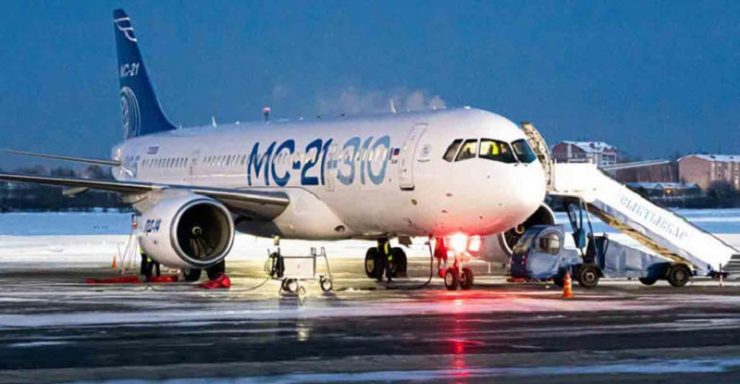

AEROFLOT has signed a contract to acquire 90 MC-21 aircraft between 2029 and 2032, expanding one of Russia’s major initiatives to gradually replace foreign-made commercial aircraft with domestically produced models.
The agreement involves the airline and three companies linked to the state-owned conglomerate Rostec: United Aircraft Corporation (UAC), responsible for aircraft production; the leasing company Aviacapital-Service; and United Engine Corporation (UEC), the manufacturer of the PD-14 engine.
According to UAC, the contract covers not only the 90 aircraft but also simulators, crew training, and 22 years of technical support. The financial value of the package was not disclosed. Rostec described the deal as the largest ever signed in the history of Russian civil aviation regarding the procurement and after-sales support of domestically produced aircraft.
The schedule entails a phased acceleration of deliveries. Aeroflot is expected to receive 14 MC-21s in 2029, 18 in 2030, 24 in 2031, and 34 in 2032, bringing the total to the 90 units specified in the new contract.
These aircraft will be added to an initial batch of 18 MC-21s previously ordered. Based on the company’s currently announced schedule, eight units from that batch are expected to arrive in the fourth quarter of 2027, with the remaining ten arriving in 2028. If the schedule is met, the Aeroflot Group is projected to receive a total of 108 MC-21s by the end of 2032.
This long-term contract is also significant for the manufacturer, as it creates predictable demand over several years at a time when the Russian aviation industry is striving to ramp up mass production of the model. Developed by Yakovlev—a company controlled by UAC—the MC-21-310 is a single-aisle, narrow-body commercial aircraft primarily designed for short- and medium-haul routes.
This segment is also occupied internationally by aircraft families such as the Airbus A320neo and Boeing 737 MAX, although differences in configuration, range, and target markets mean the various versions cannot be directly compared.
According to current UAC specifications, the MC-21-310 can carry 163 passengers in a standard two-class configuration or up to 211 passengers in a high-density layout. The aircraft measures 42.25 meters in length, has a wingspan of 35.9 meters, and a maximum takeoff weight of 85 tons.
In a configuration accommodating 175 passengers, the manufacturer states the aircraft has a range of 3,830 km and a maximum cruising speed of Mach 0.82. In June 2026, an MC-21-310 performed a demonstration flight covering over 3,800 km with a payload equivalent to 175 passengers.
Another key feature of the project is the use of composite materials, which account for more than 30% of the airframe, including wing components. The version currently being prepared for mass production is powered by two PD-14 turbofan engines, developed and manufactured in Russia by the United Engine Corporation.
The MC-21 initially relied on a mix of Russian and foreign equipment. Following the imposition of international sanctions on Russia starting in 2022, the program underwent an extensive process of replacing imported components, including onboard systems and other equipment.
This process contributed to repeated delays in the industrial schedule. Restrictions on the supply of Western technology and components have also affected other programs within the Russian commercial aviation sector.
In August 2026, the first MC-21-310 manufactured using technology intended for mass production completed its maiden flight. The aircraft was airborne for 1 hour and 23 minutes, reaching an altitude of 6,000 meters and an indicated airspeed of 600 km/h during the test. At that time, Rostec stated that more than half of the certification flight program had been completed.
Certification of the current configuration is scheduled for 2027, according to Russian authorities and the manufacturer. As the process is ongoing, meeting delivery schedules will depend on the completion of testing and the industry’s ability to ramp up production.
The introduction of 108 MC-21s marks a significant shift for the Aeroflot Group, which currently operates a large fleet of Airbus and Boeing aircraft.
The company’s announced strategy does not entail the immediate retirement of these foreign aircraft. Some Western jets are expected to remain in service over the coming decade, while new Russian aircraft are gradually integrated into the fleet. Under this scenario, the MC-21 is expected to progressively take on a larger share of the group’s medium-haul routes.
However, for the Russian industry, the challenge extends beyond merely securing orders. The critical phase lies in translating contracts into regular deliveries: commercial aircraft production in the country faces delays, supply chain constraints, and the need to develop domestic alternatives for components previously sourced from abroad.
With an additional 90 aircraft included in the contract and a schedule targeting 34 deliveries by 2032, the deal with Aeroflot will also serve as a test of Russia’s ability to ramp up MC-21 production to a scale sufficient to modernize its commercial fleet. [sources/special photo]