


 ER
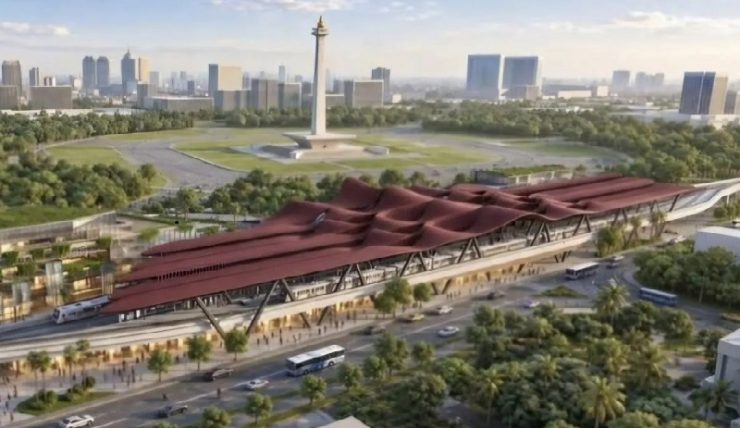

EVERY DAY, an average of around 18 thousand passengers gets on and off the train at Gambir Station. KAI notes, the figure is 3.87 million customer activities from January to July 2026. Across the road, the National Monument area on the first Sunday of Ramadan the same year received around 2,800 visitors.
Gambir and Monas have been neighbors since the elevated station was inaugurated on June 5, 1992. However, the flow of people between the two was never really designed. Passengers get off the train to immediately go somewhere else.
Meanwhile, Monas is more often visited by vehicles parked on the south side, then visitors tour the park area or inside the monument area. President Prabowo Subianto’s instructions at the Merdeka Palace, Thursday (11/5), 2026 attempted to bridge this distance.
To the President Director of PT KAI Bobby Rasyidin, the President asked to accelerate the revitalization of Gambir as a national station as well as a family tourism and recreation space. As for the Monas area, it was asked to be arranged so that it is more comfortable and has stronger historical and educational value.
To the Minister of Culture Fadli Zon, the President entrusted the idea of a Grand National Museum in the same area. When read together, these three directions change the order of visits to the heart of Jakarta: get off the train, walk, then enter history. The new building is just the tool. What wants to be reorganized is the footsteps of residents.
Bobby uses a simple parable. Gambir will be the terrace, Monas the stage. The design and construction plan translates that idea literally. A layered corrugated roof stretches over the elevated track. On the side facing the monument stretches a round, grassy courtyard that resembles an open amphitheater.
KAI said the design takes the shape of the Indonesian landscape, from waterfalls and terraced rice fields to mountains. The travel experience is designed to start before passengers aboard the train.
The terrace should also be wider. Gambir currently only has four lines and serves 34 regular long-distance train trips per day. Electric trains pass over it without stopping, so commuter passengers who want to go to Monas have to get off at Gondangdia or Juanda.
KAI plans two additional special KRL lines. Gambir will also be connected to the Monas MRT Station on the west side of the area via an underground tunnel.
The Monas MRT Station is targeted to operate by the end of 2027. In order to maintain the authenticity of the landscape of the cultural heritage area, the station entrance is designed to descend directly underground.
MRT Jakarta has also prepared a special gallery to display various archaeological finds from excavations. Later, the pedestrian route from the platform to Monas Park will take visitors gradually following the layers of the city’s history.
Gambir revitalization itself is budgeted at around IDR2 trillion. The work is divided into two stages over two years, with a target of completion in 2028. The greatest value of this project lies in its connections. Passengers will walk if the route is short, shady and has clear directions. Without this connection, the distance of less than one kilometer from the platform to the Monas monument still feels far.
The terrace and stage need filling. Under the Monas cup there is the National History Museum, an 80 x 80-meter room with a height of eight meters which is interpreted as the month of independence.
The room contains 51 dioramas of the nation’s journey. On the west side of Medan Merdeka stands the National Museum of Indonesia, which after being renovated is now visited by 5,000 to 7,000 people per day and can reach 12,000 people during holidays. The National Gallery on the east side, not far from Gambir, is being revitalized since October 2026.
The Grand National Museum is designed to complement the cluster on a larger scale. The President wants the museum to be a center for history, education, entertainment and recreation, especially for students and the younger generation. The design, exact location, schedule and budget have not been announced.
This idea grew out of the current policy direction. Throughout 2025, the Ministry of Culture will revitalize 152 cultural reserves and museums. In 2026, the acceleration extends to more than 200 cultural assets, from museums, sites and palaces to forts.
Fadli Zon has repeatedly emphasized that museums must provide real benefits to society and not stop being a place to store historical objects.
Large museums located next to the busiest transport nodes in city centers are treated like public infrastructure: buildings whose value is determined by how easy they are to reach. School visits no longer have to depend on bus rentals. In the future, a student from Bogor or Depok will just have to take the KRL, get off at Gambir, and within minutes he will be standing in front of a diorama of the nation’s journey.
Arranging an area is always more complicated than building a single building. Secretary General of the Indonesian Transportation Society Aditya Dwi Laksana reminded that the urgency of developing Gambir is very dependent on improving Manggarai Station and the transit-oriented area around it.
He proposed a division of roles. Manggarai handles inter-transit transfers, while Gambir serves certain classes of long-distance trains while opening KRL stops. KAI’s plans are in line with that proposal: Manggarai is prepared as a large-scale movement node, Gambir as a door to the city center and the Monas area.
Presidential Decree Number 25 of 1995 places the Minister of State Secretary as Chair of the Medan Merdeka Area Development Steering Commission, with the Governor of DKI Jakarta as secretary and member.
In 2020, the revitalization of the south side of Monas was stopped because it had not received the commission’s approval. This experience has been a lesson that plans in this area need to be agreed upon from the drawing stage.
This time the direction came directly from the Palace, so that coordination between the central government, KAI, MRT Jakarta and the DKI Provincial Government could be established from the start. The Grand National Museum also needs to find a place without reducing Monas’ function as a city green space.
Gambir is targeted for completion in 2028, while Monas MRT Station is a year earlier. This time span is sufficient to ensure that the three projects are carried out as one area design, complete with pedestrian paths, shade and direction signs from the platform to the museum doors.
Its success will be seen from a simple thing: how many of Gambir’s tens of thousands of daily passengers choose to cross and walk towards history. [antaranews]