

 ER
ER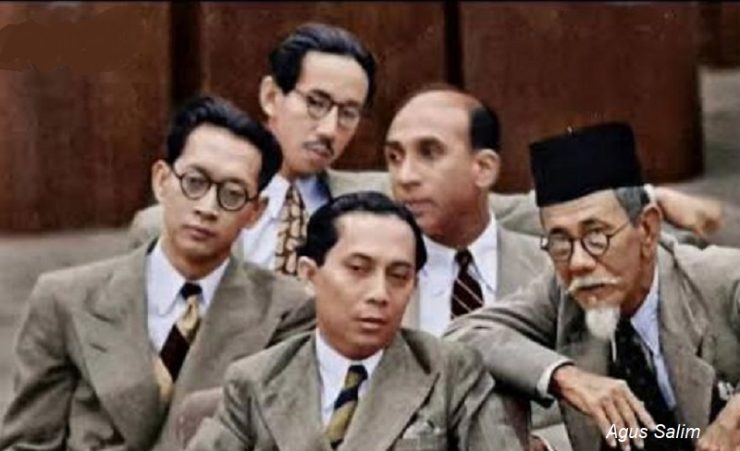

“DO individuals like Haji Agus Salim still exist?” Several days ago, retired Indonesian diplomats were asked a pointed question by citizens.
The question reflects anxiety about today’s diplomacy. H. Agus Salim was Indonesia’s third foreign minister from 1947 to 1949. Though his tenure was brief, it became legendary. A polyglot fluent in nine languages, he framed foreign policy as an expression of conviction and faith.
The Agus Salim Legacy
First, diplomatic courage. Agus Salim led Indonesia’s diplomacy when the Republic was unrecognized and the Dutch launched Military Aggression. With only a sarong, a peci, and his intellect, he “shook the United Nations.” His 1947 impromptu speech at the UN Security Council in Lake Success condemned Dutch aggression and defended Indonesia’s sovereignty.
Second, personal diplomacy. His mastery of Arabic, English, Dutch, French, German, Japanese, Turkish, Urdu, and Malay allowed him to lobby beyond formal forums. Egypt became the first country to recognize Indonesia on June 10, 1947, aided by his outreach to the Arab League.
Third, moral force. He arrived in New York in a borrowed suit. Yet his integrity won respect. Dutch statesman Van Mook admitted: “It is difficult to oppose a man who cannot be bought.”
Fourth, architect of recognition. He led Indonesia’s delegations to the UN in 1947 and the New Delhi Conference in 1949, and helped shape the Roem–Roijen Agreement. His work ensured military victories were matched by international legitimacy at the 1949 Round Table Conference.
Fifth, pioneer of “Free and Active.” Though formalized by Hatta in 1948, Agus Salim practiced it first. He refused to join either bloc, engaging the Arab League, India, and Burma while maintaining dialogue with the US. His principle remains: “Indonesia is friendly to all, subservient to none.”
Agus Salim’s power was never budget or tenure. It was courage, knowledge, integrity, and linguistic mastery.
Why ICWA Matters Now
This spirit inspired Foreign Minister Ali Alatas and Minister Joop Ave to establish the Indonesian Council on World Affairs in 1997. ICWA continued Dharma Caraka, a forum of former ambassadors. Today it includes business leaders, academics, and retired TNI-Polri (Indonesian National Army-Police) officers.
As the 1945 Constitution mandates, foreign policy must protect the nation, advance welfare, and contribute to a world order based on independence, peace, and social justice. Law No. 37/1999 echoes this.
Speed and accuracy now define diplomacy. Social media spreads hoaxes that blur fact and fiction. The answer is faster, verified information. President Prabowo Subianto’s push for responsive governance is timely. Through data analysis, ICWA can help the Foreign Ministry deliver prompt, precise statements.
The need was clear during the November 9, 2024 Indonesia-China Joint Statement on the South China Sea. Indonesia’s position was consistent, but delayed clarification risked speculation.
Another test is the Board of Peace proposed by US President Donald Trump. With Trump as permanent chair and Palestine excluded, the BoP tilts toward Israeli interests and undermines multilateralism. Indonesia’s challenge remains “rowing between two reefs.”
Adding Speed to Integrity
Ali Alatas envisioned ICWA as a strategic partner to the Foreign Ministry. That is urgent. Today’s threat is not Dutch colonialism, but eroding multilateralism amid great-power rivalry.
ICWA must preserve Agus Salim’s DNA: courage, knowledge, integrity. But it must add speed. Diplomacy in 2026 is fought on TikTok as much as at the UN. Combine senior diplomats with young IR graduates fluent in AI and supply chains. Build a “Global South War Room” with real-time data on US tariffs, Chinese projects, and Middle East conflicts.
“Free and Active” must mean rejecting military alliances while building issue-based coalitions. Indonesia can lead a Global South carbon tax group while trading with the US. Mini-literalism like an Indonesia-India-Brazil G3 on nickel and palm oil should be explored.
ICWA must strengthen ASEAN Centrality and avoid becoming an elite echo chamber by engaging students, Natuna fishermen, and palm farmers.
Agus Salim shook the UN with a sarong because of courage, knowledge, and integrity. ICWA has all three. Add speed, and Indonesia’s interests will be safeguarded.
Indonesia must continue the spirit and consistent implementation of foreign policy as practiced by H. Agus Salim and Ali Alatas. Our task is not only to make Indonesia liked by all nations, but also to ensure that Indonesia cannot be disadvantaged by any nation.