

 ER
ER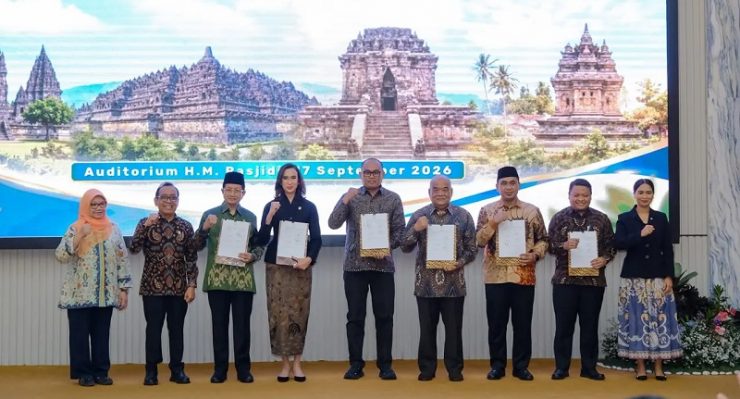

THE INDONESIAN Ministry of Tourism, alongside various ministries, agencies, and local governments, has renewed a memorandum of understanding (MoU) regarding the use of Prambanan, Borobudur, Mendut, and Pawon temples for religious purposes serving Hindu and Buddhist communities in Indonesia and worldwide.
This cross-sector collaboration is part of an effort to strengthen the role of these four temple sites as places of worship and hubs for religious and spiritual tourism, while also serving as cultural heritage assets that benefit the community through the development of high-quality, sustainable tourism.
Minister of Tourism Widiyanti Putri Wardhana stated that this strategic synergy reinforces the government’s commitment to strengthening the status of Prambanan, Borobudur, Mendut, and Pawon temples as world-class religious and spiritual tourism destinations, while prioritizing the preservation of cultural heritage. The renewal of the MoU serves to adjust the previous agreement—signed in 2022 and valid until February 2027—to reflect current conditions.
“This renewal and addendum process was undertaken to align with the latest dynamics of government administration, particularly regarding nomenclature adjustments within the current ministry and agency structures. Furthermore, this renewal refines the scope of cooperation to ensure it is more adaptive, relevant, and responsive to future tourism development dynamics at the temple sites,” said Tourism Minister Widiyanti.
The Minister of Tourism hopes that this collaboration will transform the temple areas from mere relics of the past into inclusive, sustainable spaces that integrate spiritual, cultural, educational, and tourism values with community empowerment.
“We hope these temples can serve as inclusive and sustainable gathering spaces—hosting everything from educational activities on civilization and religious tourism to religious ceremonies—that bring direct benefits to the local community. Let us work together to safeguard and preserve our nation’s cultural heritage,” she affirmed.
The scope of the collaboration includes the use of Prambanan Temple as a place of worship for Hindus, and Borobudur, Mendut, and Pawon Temples as places of worship for Buddhists.
These four sites are also intended to become high-quality, sustainable hubs for Hindu Tirtha Yatra (pilgrimage) and Buddhist Dharmayatra (pilgrimage); centers for the development of religious, cultural, and spiritual tourism; and hubs for research and innovation in religion, history, art, and culture, alongside local community empowerment.
The collaboration also encompasses the permitting and facilitation of the use of Prambanan, Borobudur, Mendut, and Pawon Temples; support for and promotion of religious, cultural, and spiritual tourism; community economic empowerment; and the preservation of the four temples as cultural heritage sites and national treasures.
Meanwhile, the Coordinating Minister for Human Development and Culture, Pratikno, commended the commitment of all parties involved in finalizing the renewal of the memorandum of understanding.
According to Pratikno, the temples are not merely architectural marvels but cultural heritage sites embodying values of religion, culture, knowledge, ethics, and civilization. Consequently, the temple areas are expected to evolve into spaces where religion, knowledge, culture, and community economic activities intersect.
Pratikno believes that expanding the utilization of these temple areas can support the realization of high-quality, sustainable tourism. Religious activities and tourism can generate economic benefits for local communities while strengthening the link between cultural heritage preservation and community well-being.
“Therefore, we call upon all segments of society to work together to ensure that the faithful can worship in peace and solemnity. Tourists can enjoy historical and cultural heritage through meaningful experiences, while the local community, the regional economy, and even the national economy can grow,” Pratikno stated.
Minister of Religious Affairs Nasaruddin Umar explained that the memorandum of understanding represents a continuation of the cooperation established in 2022. Through this partnership, Prambanan Temple is increasingly gaining recognition as a site for worship and Tirtha Yatra (pilgrimage) for Hindus, while Borobudur, Mendut, and Pawon Temples continue to be developed as spaces for worship and Dharmayatra (pilgrimage) for Buddhists.
The participation of the faithful in utilizing the Prambanan Temple complex continues to grow. In 2024, the Tawur Agung Kesanga ceremony is expected to draw approximately 10,000 participants. Utilization of the area has also expanded through the 8th Saka Yoga Festival, which involved over 500 participants.
Meanwhile, the use of Borobudur, Mendut, and Pawon temples for Buddhist religious activities has seen increased participation. In 2025, various Buddhist religious activities at these temple sites attracted 33,556 participants, including devotees from abroad. This figure represents an increase from the 24,894 participants recorded in 2024.
“Moving forward, we want Prambanan, Borobudur, Mendut, and Pawon temples to be more than just tourist destinations; we envision them as global centers of spirituality—places where the faithful can worship with solemnity. Therefore, I urge all parties to maintain a balance between utilization and preservation,” Nasaruddin concluded.
This cross-sector synergy is expected to further strengthen the global standing of Indonesia’s cultural heritage while ensuring that the development of religious and spiritual tourism remains aligned with the temples’ primary functions: as spaces for worship, centers for learning about civilization, and cultural legacies to be safeguarded across generations. [traveltext.id]