

 ER
ER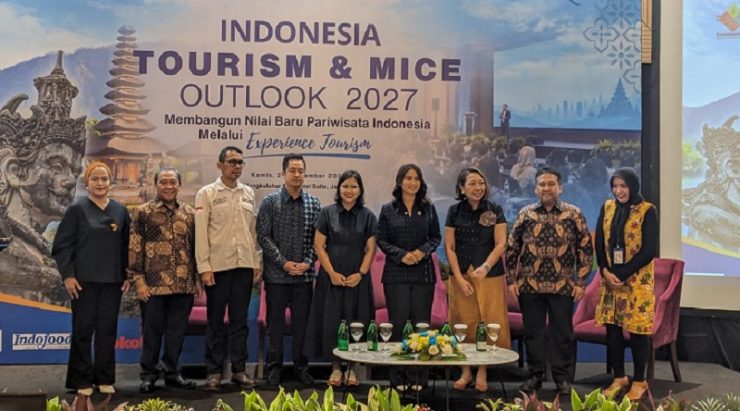

IN OBSERVANCE of World Tourism Day—celebrated annually on September 27—the Tourism and Creative Economy Journalists Forum (Forwaparekraf) hosted its flagship event, the Indonesia Tourism and MICE Outlook (ITMO) 2027. The event was themed “Building New Value for Indonesian Tourism Through Experience Tourism.”
The event held at the Mangkuluhur ARTOTEL Suites Jakarta, and was officially opened by the Deputy Minister of Tourism Ministry, Ni Luh Puspa. In her remarks, she emphasized that today’s travelers do not merely visit destinations; they seek authentic, personal, and meaningful experiences. This trend is particularly evident among Millennials and Gen Z, 52% of whom are willing to pay a premium for high-quality travel experiences.
“The ability of Indonesia’s tourism stakeholders to meet this traveler interest will positively impact both the length of stay and total tourist spending. To address this, the Ministry of Tourism is enhancing the quality of experience-based tourism by leveraging two of the six global tourism trends: MICE and ‘bleisure’—a blend of business and leisure travel,” she stated.
Ni Luh Puspa explained that, according to the ICCA Global Watch Business Analytics Country and City Ranking 2025, Indonesia ranks 37th globally and 4th within ASEAN. Alongside MICE, the “bleisure” trend is gaining momentum, as event attendees often extend their trips beyond the event itself to enjoy local attractions.
“Looking at Singapore—a key regional competitor—Indonesia faces a significant task in robustly integrating its tourism ecosystem, from attraction operators and hotels to culinary providers, to deliver high-quality travel experiences,” she said. She added that the development of Indonesia’s MICE sector must shift from merely hosting events to creating valuable experiences. These experiences should strengthen destinations, stimulate the local economy, and boost Indonesia’s competitiveness on the global MICE stage.
“In other words, Indonesia offers not just venues, but the experiences within them,” Ni Luh Puspa added.
Moreover, the multiplier effect generated by hosting events touches various sectors. According to data from the Ministry of Tourism, the “Event by Indonesia” program attracted 12.2 million visitors throughout 2025, mobilizing 20,887 MSMEs and involving a workforce of 257,561 people, including artists and community members.
Meanwhile, the Ministry’s Deputy for Marketing, Ni Made Ayu Marthini, added that experiential tourism represents the future of tourism development in Indonesia as the country strives to create high-quality tourism. Three key components are essential to achieving this: respect for culture, nature, and human connections. Without these three elements, experiential tourism lacks quality.
“Since last year, the Ministry has developed three flagship programs to serve as the backbone of experiential tourism in Indonesia: gastronomy, wellness, and marine tourism. Moving forward, the Ministry is adding two more programs: textile tourism (*wastra*) and arts and culture tourism,” she noted.
She explained that the government can provide direction and set trends, moving away from the habit of visiting the same old places—a shift away from mass tourism, a scenario we fear and wish to avoid.
Representing tourism industry players, Hariyadi Sukamdani, Chairman of the Indonesian Tourism Industry Association (GIPI), emphasized the importance of the government planning and implementing sustainable programs. He noted that the government should prioritize long-term continuity over short-term projects to ensure lasting success.
“Indeed, quality tourism can be planned by considering various aspects, such as exploring the region’s potential, establishing conducive regulations, offering investment incentives, and creating attractive public-private partnership frameworks for investors,” said Hariyadi.
Likewise, Erastus Radjimin, founder and CEO of ARTOTEL Group, emphasized that creating a better travel experience can be achieved by observing current lifestyle trends—specifically, the healthy lifestyle trend.
“To that end, we are addressing guest needs by enhancing the sleep experience. People today use health trackers; they check their sleep scores. That is the aspect we are continuously trying to improve,” said Eri, as he is familiarly known.
Furthermore, the company plans to launch the Wanderlust Recovery Center—a gym facility—to cater to guests who lead active lifestyles. “Because looking ahead, one in three travelers will require a gym,” he affirmed.
ITMO 2027 was made possible through the support of various parties, namely the Ministry of Tourism, ARTOTEL Group, Mangkuluhur ARTOTEL Suites Jakarta, Injourney, Injourney Hospitality, Kokola, Indofood, and Yogadihotel.
“This event feels particularly special; beyond combining the celebration of World Tourism Day, it also marks the moment we celebrate nine years of the Indonesia Tourism Outlook,” concluded Forwaparekraf Chairperson Tiara Maharani Kusuma. [traveltext.id]