

 ER
ER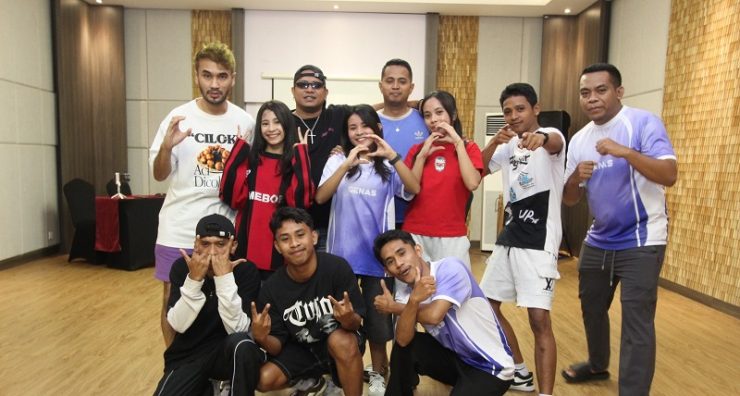

SOME dreams require a journey that extends far beyond the path to a stage. For Silet Open Up, Juan Reza, Jacson Zeran, Diva Aurel, and Official Genas, that dream began in Eastern Indonesia—navigating limited facilities and long, arduous journeys—eventually leading them all the way to Incheon, South Korea.
On Saturday, November 7, 2026, the Namdong Stadium in Incheon will bear witness to the journey of these young talents. They are set to perform at the Round Festival—an annual music festival organized through a partnership between ASEAN nations and South Korea—as part of the Eastern Indo Collective (EIC), a music collective initiated by Joshua Matulessy, also known as JFlow.
They arrive not merely to sing songs or entertain an audience; they bring with them the rhythms of their homeland and a cultural identity they wish to share. Theirs is a story of young people who keep moving forward, even when the road to the global stage is far from easy.
From the Kei Islands in Southeast Maluku to South Korea, this journey is encapsulated by a single spirit: “From Kei to Korea.”
When Eastern Rhythms Become a Global Language
Eastern Indonesia possesses a wealth of sounds, movements, and traditions rooted in the lives of its people. In the hands of the younger generation, this heritage finds new ways to reach a broader audience—blending with modern music while retaining its original character.
This concept serves as the heartbeat of the Eastern Indo Collective’s (EIC) performance. In a set lasting approximately 25 minutes, EIC weaves together traditional elements, percussion, modern arrangements, and dance into a seamless, cohesive presentation.
The performance opens with an ethnic atmosphere, which then transitions into a medley of popular songs from Eastern Indonesia. DJ Chito Deona curates the musical arrangements, while Official Genas brings the high-energy dance style that has gained recognition through viral dance trends. The concept is simple yet carries a powerful message: culture does not need to remain static to stay rooted. It can evolve with the times, embrace new sounds, and reach audiences in other parts of the world.
For JFlow, this collective also serves as a way to open doors for more talent from Eastern Indonesia. His involvement with the ASEAN-Korea Music Committee (AKMC) has given him the opportunity to consider how Indonesia might present itself with a fresh approach within the context of musical exchange between ASEAN and South Korea.
While Indonesia previously sent individual singers to perform at such festivals, JFlow has proposed a collaboration—bringing together a group of singers, musicians, and dancers, each contributing a unique flavor to a single performance.
This idea initially faced a challenge, as the organizers had allocated only one performance slot per country. However, the EIC concept offered something far more expansive: a stage that encapsulates the diverse musical and cultural expressions of Eastern Indonesia.
Among the planned performances, one moment stands out: the coming together of Silet Open Up, Juan Reza, Jacson Zeran, and Diva Aurel to perform “Tabola Bale.” According to the press release, the song has garnered approximately 580 million views on YouTube—a figure that speaks to the song’s vast reach in bringing the musical essence of Eastern Indonesia to a global audience.
Yet, despite the song’s popularity, bringing these four artists together on the same stage was no simple feat. Since the track’s release, they had never performed it live together.
The Round Festival in Incheon has provided the long-awaited opportunity. The four artists—known to the public through this very song—will share the stage, bringing to life the same energy that listeners have previously experienced only through recordings and screens.
The presence of Official Genas further completes this story. This dance creator from the Kei Islands gained recognition for a dance that helped propel the popularity of “Tabola Bale.” Together with five other dancers, he will bring the choreography—an integral part of the song’s journey—to an audience in South Korea.
Music and dance converge here into a single narrative. While the widely known song serves as an entry point, the people behind it reveal that any creative work involves a long journey defined by creativity, togetherness, and hard work.
A Long Journey Unseen on Stage
Before the stage lights illuminate in Incheon, the members of EIC must navigate a long and arduous path. For this group from the Kei Islands, distance is more than just a figure on a map; it represents the time, financial resources, and immense effort that had to be gathered for this opportunity.
To reach Yogyakarta—where they underwent their preparations—the group undertook a sea voyage lasting approximately five days. They made stops in several locations, including Banda Neira, Ambon, and Makassar, before continuing their journey to Surabaya and, finally, Yogyakarta.
Limited transportation options force them to depart much earlier than others. Meanwhile, the cost of traveling from the Kei Islands to Jakarta can reach between IDR10 million and IDR11 million, according to JFlow.
For talent hailing from island regions, the opportunity to perform abroad does not always begin with a simple plane ticket and a rehearsal schedule.
“There are journeys that must be carefully planned, needs that must be met, and support that must be sought—all to ensure that a dream doesn’t come to an end before reaching its destination,” said JFlow when approached by 40 media outlets from the Media Network syndicate.
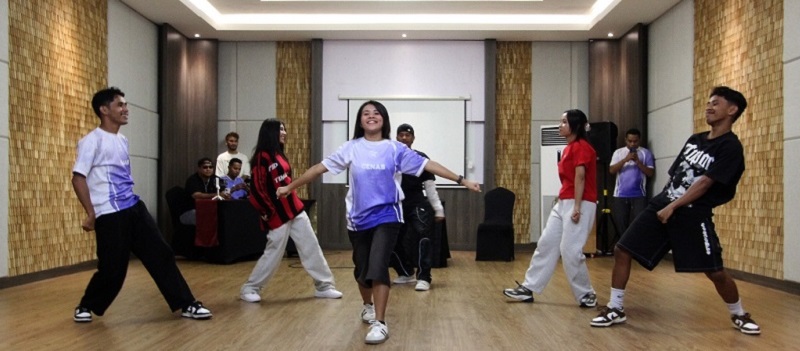
For some members, this journey even marks their first time flying, visiting Jakarta, and traveling abroad. Despite these limitations, they continue to train. They synchronize their movements, align their rhythms, and prepare themselves so that every minute spent on stage leaves a lasting impression on the audience.
The six dancers who make up the “Official Genas” group are also related by blood. These family ties are an integral part of their journey—a journey that has now brought the name of the Kei Islands to an international stage.
“From Kei to Korea” is, ultimately, more than just a travel slogan. It encapsulates a story of the distances covered, the opportunities fought for, and the firm belief that young people from remote regions also deserve a stage of their own.
When Support Opens the Way
This long journey was not undertaken alone. During their preparations in Yogyakarta, the ARTOTEL Group provided rehearsal facilities and accommodation for the EIC members. Further support came from Bank BTN, DANA, the Indonesian Ministry of Culture, HMNS Perfume, and other partners.
Eduard Rudolf Pangkarego, Chief Operating Officer (COO) of the ARTOTEL Group, views the support for EIC as part of an effort to provide space for local talent to flourish and to showcase Indonesia’s potential to the world. “Indonesia’s cultural wealth and human resources deserve the opportunity to be showcased on the international stage. The stories of EIC members—who have persevered despite coming from remote island regions—serve as a compelling reason to support this initiative,” Eduard said.
“The training facilities available in Yogyakarta have enabled the members to unify their performance concepts. Previously separated by vast distances and busy schedules, they now have a dedicated space to rehearse together, refine their arrangements, and ensure that the musical and dance elements blend seamlessly,” he affirmed.
Support of this nature demonstrates that the journey toward the global stage is not merely a matter of individual talent. It also requires space for practice, access to travel, financial backing, and the trust of those willing to pave the way.
For the members of EIC, this opportunity is part of a larger endeavor: to prove that limited access does not have to restrict the reach of one’s creative work. [traveltext.id]