

 ER
ER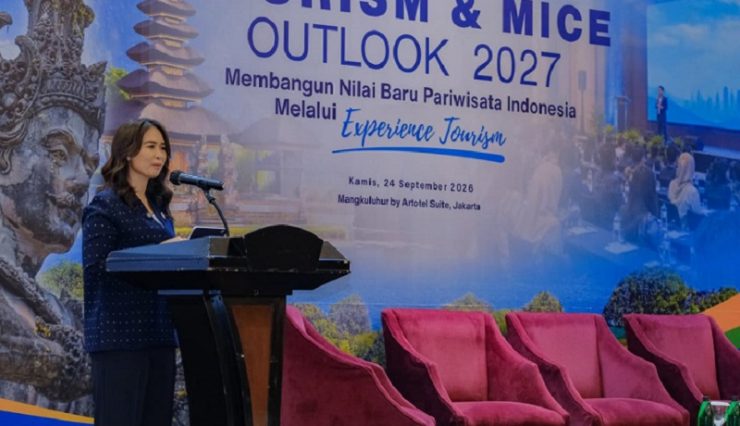

DEPUTY Minister of Tourism Ni Luh Puspa is advocating for the development of the Meetings, Incentives, Conventions, and Exhibitions (MICE) sector as a key lever to generate greater economic value from tourism activities while simultaneously strengthening the competitiveness of Indonesian destinations.
Speaking at the Indonesia Tourism & MICE Outlook (ITMO) 2027—organized by the Forum Tourism and Creative Economy Journalists (Forwaparekraf) at Mangkuluhur ARTOTEL Suites, Jakarta, on Thursday (9/24), 2026 —she noted that Indonesia’s tourism performance continues to show positive growth.
Throughout 2025, Indonesia recorded 15.39 million foreign tourist visits and US$1.20 billion in domestic tourism travel, while tourism foreign exchange earnings reached approximately US$18.27 billion.
This positive trend continued into the first half of 2026. According to data from Statistics Indonesia (BPS), foreign tourist visits reached 7.45 million, a growth of 5.71% compared to the same period the previous year.
However, Ni Luh Puspa, explained that tourism growth cannot be measured solely by the number of visits. The challenge ahead lies in translating this growth into longer stays, higher tourist spending, quality experiences, and broader economic benefits for the community.
“One segment with immense potential for further development is MICE,” she stated.
Based on data from the ICCA GlobeWatch Business Analytics – Country & City Rankings 2025, Indonesia recorded 110 international association meetings. This achievement placed Indonesia 37th globally, 10th in the Asia-Pacific region, and fourth within ASEAN.
In the Indonesia Tourism Outlook 2025/2026, the MICE and “bleisure” ecosystems—a blend of business travel and leisure—were also identified as one of the six key trends in national tourism. This trend indicates that business travel is becoming increasingly intertwined with leisure activities and the pursuit of destination-based experiences.
According to the Deputy Minister of Tourism and Creative Economy, various MICE (Meetings, Incentives, Conferences, and Exhibitions) activities offer participants the opportunity to extend their stays while boosting local economic activity. After attending the main event, participants can enjoy urban tourism, culinary experiences, wellness activities, and shopping for local products, as well as visit various tourist attractions near the event venue.
“Travelers visiting for business or events no longer simply attend conferences, meetings, or concerts. They also want to enjoy local offerings—from shopping and culinary experiences to visiting various tourist attractions. We need to strengthen the integration of these elements so that they connect into a solid, unified ecosystem,” she said.
Therefore, the future development of MICE in Indonesia must transform from merely hosting events into creating valuable experiences.
These experiences are expected to reinforce the destination’s character, stimulate the local economy, and enhance Indonesia’s competitiveness on the global MICE stage. Indonesia offers not just venues, but also distinctive and memorable experiences that accompany every event.
The deputy minister explained that the economic impact of an event does not cease when the activity concludes. Economic benefits flow into various sectors—including hospitality, dining, transportation, MSMEs, and the creative economy—while also generating local employment.
The “Event by Indonesia” program, for instance, attracted 12.20 million visitors throughout 2025, involved 20,877 Micro Small and Medium Enterprises (MSMEs), created jobs for 257,561 people, and generated an economic turnover of IDR23.76 trillion.
“When participants arrive, they use transportation, stay in hotels, enjoy local cuisine, shop for local products or souvenirs, and visit area attractions. Consequently, the value of an event does not end when the stage lights go out or the conference room closes,” Nih Luh affirmed.
Technology Enhances the Traveler Experience
On this occasion, the Deputy Minister of Tourism and Creative Economy highlighted the importance of adopting technology as the industry enters the Tourism 5.0 era. Leveraging technology is considered increasingly vital for delivering services and travel experiences that align with travelers’ needs.
One example of this implementation is the use of MaiA—an Artificial Intelligence (AI)-powered platform on the Indonesia.travel website—which helps travelers plan their trips in a more personalized way.
According to the deputy minister, technological advancements must go hand-in-hand with collaboration among all stakeholders to improve destination readiness, connectivity, and the quality of human resources.
This synergy plays a crucial role in strengthening Indonesia’s position as a premier destination for business events in the ASEAN region, while simultaneously ensuring that MICE activities generate broader economic benefits for the destination and the local community.
“The new value of Indonesian tourism lies in our ability to transform every event into an experience, and every experience into meaningful value,” concluded Ni Luh Puspa. [traveltext.id]