

 ER

FIVE INDONESIAN earth parks or geoparks succeeded in maintaining UNESCO green card status in the UNESCO Global Geoparks 2026 revalidation process which took place in Paris, France, on 2-4 November 2026.
The five geoparks are Belitong, Merangin Jambi, Ijen, Raja Ampat, and Maros-Pangkep. Meanwhile, Bojonegoro was declared qualified as a new UNESCO Global Geopark (UGGp), while Ranah Minang Silokek had the opportunity of two years to complete UNESCO’s recommendations before being proposed as a new UGGp.
According to Tourism Minister Widiyanti Wardhana said this achievement reflects Indonesia’s efforts to strengthen geopark governance, preserve geological heritage, and develop sustainable tourism.
“The status of world geoparks must be maintained through strong governance, real conservation and involvement of local communities. We want the existence of geoparks to not only be Indonesia’s pride at the world level, but also be able to provide economic benefits and improve the welfare of the surrounding community,” said Widiyanti in an official statement confirmed in Jakarta, Friday (11/06), 2026.
The results of the revalidation were presented at the 11th Session of the UNESCO Global Geoparks Council which took place on 2-4 November 2026. Green card status for the five geoparks was determined through voting by members of the World Geoparks Council.
One of the important achievements was achieved by Belitong UGGp, which succeeded in obtaining a green card again after receiving a yellow card in revalidation in 2024. During the two-year improvement period, the management together with the regional government followed up on UNESCO recommendations, especially regarding the commercialization of Batu Satam and turtle conservation standards.
The Belitung and East Belitung Regency governments issued a circular prohibiting the commercialization of Batu Satam. Meanwhile, turtle conservation activities are focused on China Island which is managed by the Ministry of Maritime Affairs and Fisheries.
Ijen UGGp, which is in Banyuwangi and Bondowoso Regencies, is undergoing its first revalidation since it was established on May 24 2023. The area with 21 geosites has an active crater with the largest acid lake in the world and the blue fire phenomenon.
Merangin Jambi UGGp also managed to retain its green card. The area designated in 2023 has an ancient limestone landscape and the Masurai Caldera is around 33,000 years old. One of the evaluation notes relates to illegal gold mining activities around the river where the Muara Karing fossils are located.
Following up on this problem, the management together with the regional government are trying to close mining activities carefully because they are directly related to the lives of local communities.
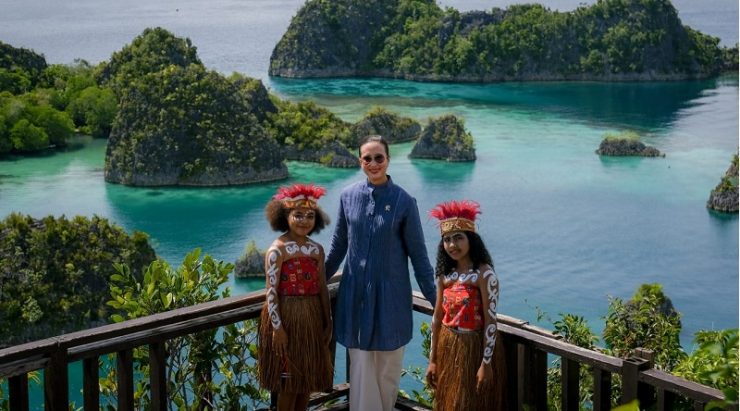
Meanwhile, Raja Ampat UGGp succeeded in completing six recommendations from the previous evaluation. Improvement efforts include the identification of four new geosites on Misool Island by 2024, the construction of a Geological Information Center on Waisai and an information center on Yefman Island, as well as increasing the involvement of indigenous communities in cultural preservation and geosite protection.
The Maros-Pangkep UGGp will undergo its first revalidation on 27-31 July 2026. The area of 5,254.10 square kilometers covering land and water has world-class karst landscapes, more than 720 caves, prehistoric rock art heritage, marine conservation areas and high biodiversity.
Widiyanti emphasized that UNESCO’s recognition is a shared responsibility to protect Indonesia’s natural, geological and cultural wealth so that it remains sustainable while providing real benefits for the surrounding community. [traveltext