

 ER
ER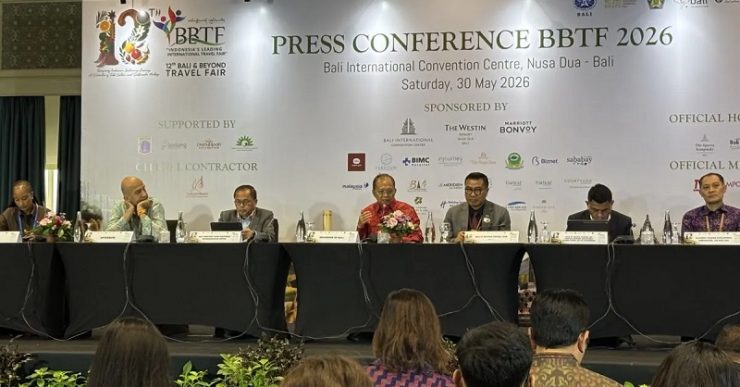

BALI’s Governor Wayan Koster noted that Bali’s tourism foreign exchange contribution throughout 2025 will contribute 55% to the total national tourism foreign exchange.
“If you compare IDR176 trillion (Bali’s tourism foreign exchange) to IDR320 trillion nationally, you get 55%,” he said at the Bali & Beyond Travel Fair (BBTF) 2026 travel exhibition in Badung Regency on Saturday (May 29).
Governor Koster explained that the 55% figure is derived from calculating foreign tourist visits and expenditures, with foreign tourist visits alone totaling 7.05 million throughout 2025, or 45.8% of the total 15.39 million foreign tourist visits to Indonesia.
Statistics Indonesia (BPS) data revealed that the average expenditure of foreign tourists during a visit to the Island of the Gods was approximately US$1,522.44. Multiplying this by the total number of visits and converting it to the US dollar exchange rate of IDR16,500, yields IDR176 trillion in Bali’s tourism foreign exchange through 2025.
“That’s foreign tourist spending, according to the formula, which translates into tourism foreign exchange, foreign currency circulating in Bali spent on hotels, transportation, restaurants, and Micro Small and Medium Enterprises (MSMEs). It’s IDR176 trillion, while in Indonesia the total is IDR319.9 trillion, or already IDR320 trillion,” said the governor.
According to Governor Koster, this significant contribution indicates that Bali’s tourism sector is not easily shaken, considering that 2025 faced many negative issues. Instead, the Bali Provincial Government promised to continue addressing pressing issues such as waste, infrastructure, and traffic congestion, ensuring tourism’s resilience.
Furthermore, tourism contributes 66% to Bali’s economy, and this data also impacts Bali’s economic growth in 2025, which is expected to reach 5.82%.
“The per capita income is IDR72 million, the poverty rate is 1.42%, the lowest in Indonesia, and the unemployment rate is 1.45%, also the lowest in Indonesia. This also has an impact on agriculture and fisheries, as many hotels use local Balinese products: fruit, vegetables, eggs, and rice,” Koster affirmed.
The Bali Provincial Government believes that tourism not only brings in foreign exchange but also contributes to other economic sectors, especially those that directly impact the community.
This makes Bali the fifth-highest economic growth in Indonesia, making it the first province without mining resources.
“Tourism encourages farmers, fishermen, and artisans, and its impact on the community is high. This differentiates tourism from the natural resource-based world. While that sector has a small number of owners but a lot of money, this sector is spread out, with numerous hotels, restaurants, travel agencies, farmers, and MSMEs,” he concluded. [antaranews]