

 ER
ER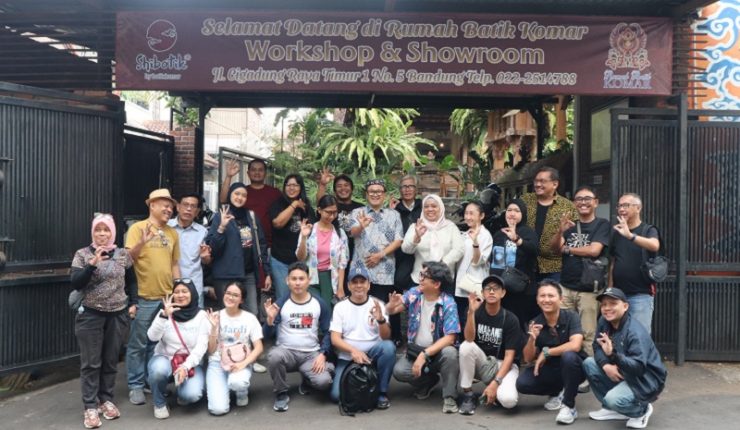

THE SINDIKASI Media Network (SMN) visited the Rumah Batik Komar Workshop in the Cigadung area of Bandung, West Java, as part of its efforts to broaden its understanding of the development of the national batik industry and strengthen its network of cultural and creative economy news outlets.
The visit was welcomed by the founder of Rumah Batik Komar, Dr. H. Komarudin Kudiya, who explained the history of the institution he founded in 1998. According to Komarudin, Rumah Batik Komar was established not only as a batik production center, but also as a center for education, research, innovation, documentation, and preservation of Indonesian batik.
During the workshop, Komarudin highlighted the public’s lack of understanding of batik. He said many people only see the beauty of the motifs, without understanding the process, philosophy, and techniques of its creation. He also emphasized that printed batik cannot be compared to batik made through a dye-resistance process using hot wax.
“People often judge batik solely by its appearance. However, batik has a process, expression, and cultural value that printed batik cloth doesn’t have,” he said.
Komarudin emphasized that Indonesia need not worry about various cultural claims from other countries as long as it can maintain quality, innovation, and the regeneration of batik makers. He believes that mastering batik knowledge and technology is the main asset for strengthening Indonesian batik’s competitiveness on the global stage.
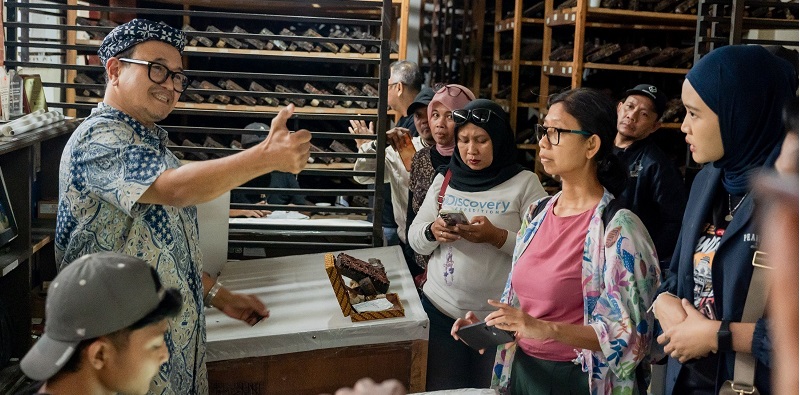
During the visit, participants were also introduced to various technological innovations developed by Rumah Batik Komar. One of these is the Batik Pendulum, a tool that utilizes a swinging motion to distribute hot wax, producing distinctive patterns and lines.
In addition, Rumah Batik Komar has developed various canting devices, work tables, and other equipment to support the production process, aimed at increasing efficiency without eliminating the hand-held touch of the batik maker.
Komarudin emphasized that technology should be a tool, not a substitute for human skill. As long as the batik-making process still uses hot wax as a color barrier and is carried out using batik techniques, these innovations remain within the framework of batik preservation.
In addition to witnessing the production process of hand-drawn and stamped batik, the SMN group also viewed a collection of over 10,000 batik designs, approximately 4,000 copper stamping cantings, and various books on batik research published by Komarudin. Rumah Batik Komar has also obtained four industrial patents related to the development of batik-making tools.
Through its Batik Education program, Rumah Batik Komar has provided opportunities for students, university students, academics, MSMEs, and the general public to learn about the history, philosophy, and techniques of batik making, as well as batik business development. These training programs have been implemented in various regions, from Aceh to Papua, as part of an effort to expand the regeneration of Indonesian batik makers.
The Sindikasi Media Network visit is expected to be the first step in collaboration to strengthen public awareness of Indonesian batik. Through educational reporting, the media is expected to increase public literacy about the differences between authentic batik and batik-patterned textiles, while encouraging the preservation of Indonesia’s cultural heritage through innovation, documentation, and ongoing education. [traveltext.id]