
 ER
ER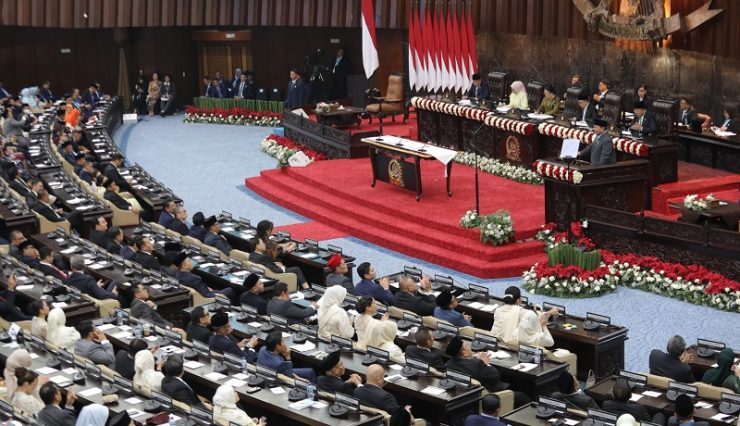

THE MINISTRY of Creative Economy (Ekraf) attended the first Plenary Session of the House of Representatives (DPR RI) for the 2026 legislative year, which featured the presentation of the 2027 State Budget (APBN) Bill by President Prabowo Subianto.
Speaking at the DPR RI building in Jakarta on Friday (August 14), President Prabowo stated that the government positions the 2027 State Budget as an instrument to maintain economic growth momentum while simultaneously boosting public welfare. Budgetary policies are also designed to align with fiscal reform, spending efficiency, and the strengthening of targeted social protection.
“The government is also promoting innovative and sustainable financing, with the aim of reducing poverty, open unemployment, and inequality by 2027. We do not choose between growth and prudence; we choose both. We do not choose between helping the people and safeguarding the state budget,” said Prabowo.
He explained that the government is pursuing both objectives. Indonesia possesses robust economic growth prospects, generally prudent macroeconomic policies, and a debt burden that is relatively prudent and sustainable compared to peer nations. Economic fundamentals are assessed as solid, government policies as effective, and the economy as resilient against external shocks, with inflation kept under control.
Indonesia’s economy, Prabowo continued, continues to grow amidst global pressures and uncertainty. In the first semester of 2026, economic growth reached 5.45%, while state revenue grew by 21.3% and state expenditure increased by 18.2% year-on-year through the end of July 2026. The state budget deficit was recorded at 0.91% of Gross Domestic Product (GDP). The government targets 6% economic growth for 2027, with inflation maintained within the 2.5% range.
The 2027 Draft State Budget (RAPBN) is designed with state expenditure of IDR4,097.2 trillion, an increase from the IDR3,842.7 trillion allocated in the 2026 State Budget (APBN). State revenue is projected to reach IDR3,153 trillion, while financing is planned at Rp671.2 trillion, resulting in a deficit of 2.40% of GDP.
This fiscal policy is directed toward supporting eight National Priority Work Programs, covering food sovereignty; energy and water self-sufficiency; education; health; downstreaming and industrialization; infrastructure, housing, and disaster resilience; as well as strengthening the people’s economy and rural development.
“Fiscal, monetary, and financial sector policies are working in synergy and becoming increasingly solid. Economic transformation toward high-value-added economic activities must continue to be strengthened. Flagship programs must be implemented effectively,” he said.
President Prabowo added that these eight priorities are supported by the strengthening of defense and security, law enforcement, governance, the acceleration of digitalization, and economic diplomacy. “It is my sincere hope that the deliberations on the 2027 Draft State Budget are conducted openly and constructively, with a full orientation toward the interests of the people and the nation.”
In line with this direction, the Ministry of Creative Economy is strengthening the creative economy sector’s contribution by developing an ecosystem based on creativity, innovation, intellectual property, talent, and entrepreneurship. This strengthening effort is strategically grounded in Presidential Regulation Number 37 of 2026 concerning the Creative Economy Master Plan (Rindekraf) 2026–2045. This regulation serves as a medium- and long-term development guide for central and regional governments in developing the creative economy sector and ecosystem.
Meanwhile Minister of Creative Economy Teuku Riefky Harsya stated that Rindekraf serves as a crucial instrument to ensure that the development of the creative economy aligns with the national economic growth agenda. According to him, development initiated at the regional level can expand the benefits of the creative economy while creating more opportunities for the community to generate value-added products from local potential.
“Rindekraf provides a clear direction for developing the creative economy as a new engine of national economic growth. We encourage the transformation of creativity, intellectual property, talent, and regional potential into productive economic activities, ensuring that the benefits reach communities ranging from the village level to the global market,” said Teuku Riefky.
This direction is being implemented through several flagship programs of the Ministry of Creative Economy, including the Creative Village Activation—aimed at developing villages and urban communities into creative economy hubs—and the Creative Hub Activation, which serves as a space for talent development and creative entrepreneurship.
Additionally, the “Creative by Indonesia” initiative accelerates the development of local intellectual property by fostering a spirit of “local heroes going national” and “national champions going global.” The Ministry also supports the government’s agenda to alleviate poverty, eradicate extreme poverty, and boost national economic growth.
“The creative economy holds immense potential to support the people-based economy, job creation, and value-added enhancement. Therefore, we will continue to ensure that creative economy programs align with national development priorities and can be implemented concretely in the regions,” concluded Teuku Riefky. [traveltext.id]